NAME CALLING: FRENCH BUTCHERS HAVE A BEEF
French butchers have a beef. They are offended by the habit, especially in the media, of referring to genocidal monsters as “butchers”.
History indeed counts many evil butchers. In France, we still have in memory the heinous crimes of Gestapo chief Klaus Barbie, who was responsible for the torture and murder of thousands during the Second World War. Barbie was known at the “Butcher of Lyon”.
Today, another odious war criminal has just been hauled before the courts of international justice: Serbian nationalist Ratko Mladic, charged with the slaughter of some 8,000 Bosnians nearly two decades ago. Mladic has been dubbed the “Butcher of the Balkans” — or, in French, the Boucher des Balkans. Meanwhile, the Libyan dictator Muammar Gaddafi has been accused of “butchering” his own people. His enemies call him the “Butcher of Libya”. French butchers have had enough. They claim that the misappropriation of the word “butcher” has, well, butchered the reputation of their estimable trade. Quoted in French press articles this week, their spokesman Bernard Merhet denounced the use of “butcher” and “butchery” to describe wicked men and their monstrous acts. “The butchers of France are upset by the use of these words that denigrate our profession,” he said. “Other words can surely be found that suggest the same meaning.”
Merhet didn’t propose any alternative language, though a quick survey of potential candidates (baker, doctor, cobbler, pharmacist) doesn’t seem to produce any substitutes that evoke the same degree of unspeakable horror and outrage. One has only to visit any local boucherie — not to mention the more disturbing experience of a visit to the abattoir — to get a close-up look at the cruel bloodiness of the butcher’s art.
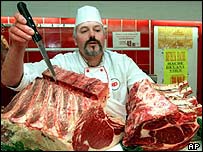 On closer inspection, the butchers’ beef cuts more deeply into the fabric of French society, revealing familiar reflexes in the highly ritualised spectacle of interest-group posturing. France is a society in which trades and professions are rigidly organised into so-called corporatist lobbies. The word “corporatist” in English seems academically esoteric, but in French it’s a familiar term that everyone grasps — if only because it describes so precisely how French society is structured and functions. In France, professions are organised as closed systems of self-interest, and each strives to extract a maximum amount of monopoly privileges and economic benefits from the state — usually at the expense of the French population as a whole. When these professional lobbies are disgruntled — or, worse, infuriated — by any perceived threat to their interests, they make the whole society pay.
Anyone who lives near the Eiffel Tower, as I do, knows that whenever French farmers are unhappy with the price of their products, they invade the capital in trucks and tractors and dump their unsold goods on the Champ de Mars. I have seen the entire area at the foot of the Eiffel Tower overrun with thousands of confused sheep. For the animals, admittedly, a brief getaway to the Champ de Mars is undoubtedly preferably to a one-way trip to the abattoir. For Parisians, the spectacle is a huge inconvenience. Which, of course, is precisely the intention.
Evidence of French corporatism in daily life here is everywhere. Try to find a taxi in the streets of Paris — it’s almost impossible. Why? Because the taxi lobby keeps their numbers down and competition out. Try to buy Aspirin or Listerine mouthwash in a French supermarket — you can’t. Why? Because the pharmacist lobby has a monopoly on those products — and charges huge mark-ups. Economic life in France is structured as a regulated system of segmented monopolies.
The goal of French corporatism is usually economic. Lobbies for butchers, bakers, farmers, pharmacists, taxi drivers and other trades and professions seek to maximum their material gains at the inconvenience of French society as a whole. What is unusual about the French butchers’ protests is that their complaint isn’t about material gains at all — it’s located on the level of symbolic injustice. French butchers are not complaining about the low price of meat; they are whingeing about the semantic use of a word — “butcher” — to describe genocidal madmen.
It might be argued that their indignation shows that French butchers have feelings too. Or, more likely, that corporatist reflexes run so deep in French society that any perceived prejudice to a professional interest — even symbolic — is automatically denounced resolutely. These demonstrations of muscle-flexing, frequently not without unintentional comical effect, are common forms of political entertainment in France. The butchers’ complaint, which is little more than bluster, may be the first protest motivated by wounded pride.
The “Boucher des Balkans” meanwhile languishes in jail awaiting his trial for genocide. For French butchers, the media skewering of their good name is not over.