THIS IS THE END: JIM MORRISON’S FINAL DAYS
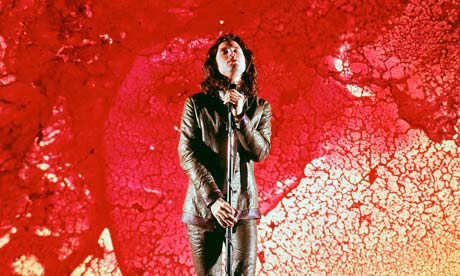
Jim Morrison died exactly forty years ago in Paris. His last day in this world was July 2 1971. He expired in the early hours of the morning of July 3rd.
It’s a tribute to Morrison’s status as a pop icon that legions of his fans still, forty years later, make the pilgrimage to Paris all year round to visit his gravesite in Père Lachaise cemetery. They undoubtedly will be more numerous than usual on this anniversary of his death. Several Jim Morrison commemoration tours have been organised this weekend, promising to take fans on visits to the various Paris locations associated with Morrison in the last few months of his life.
I must confess that, while there are some Doors songs that I really like, I’ve never been a huge fan. I was too young to appreciate The Doors when they were at the height of their fame in the late 1960s; and by the time I was a teenager in the 1970s, other rock sounds — David Bowie, Led Zeppelin, Pink Floyd, Genesis, Elton John — had moved pop music in new directions. Still, Morrison’s fame as a pop culture icon endured, thanks not only to the Doors’ music but also, and perhaps mainly, to his physical charisma and sexual energy. His iconic status resonated powerfully in the two decades after his death with the release of two Hollywood movies: first, Francis Ford Coppola’s Apocalypse Now featuring Morrison’s haunting singing in “The End”; and second, Oliver Stone’s biopic of Morrison, The Doors.
I have a strangely personal connection with Jim Morrison’s death. He died on my birthday: July 3rd. Also, twenty years ago I was a young journalist living in Paris and wrote a column for the Montreal Gazette on the twentieth anniversary of his death. I remember visiting his gravesite in Père Lachaise and coming across a small group of diehard fans who were drinking booze and listening to Doors music on a boom box right over the singer’s grave (in photo above). The gravestone features an inscription in Greek: ΚΑΤΑ ΤΟΝ ΔΑΙΜΟΝΑ ΕΑΥΤΟΥ. Roughly translated, it means “true to his inner demons” or “true to his own spirit”. It’s hard for me to believe that, since that date, another two decades have past. I am twenty years older, Jim Morrison has been in his cold grave for two more decades — and I’m here again writing about the anniversary of his death. This time, not the twentieth anniversary, but the fortieth.
Much has been written about Morrison’s final days in Paris, and some facts are disputed. We know for certain, however, that he arrived here in March 1971, only a few months before his death, looking to escape what he resented as the oppression of fame in America — especially after his arrest for indecent exposure and profanity during a Doors concert in Miami. Sentenced to six months in prison and a $500 fine, the case was on appeal when Morrison fled to France. Beyond those legal troubles, Morrison came to Paris because he wanted to live anonymously while connecting with the city famous for poets Baudelaire and Rimbaud and avant-garde playwright Antonin Artaud. The pop star was, in a sense, searching for his own artistic rebirth as a poet. And yet, tragically, he came to Paris to meet his end because he couldn’t escape his own demons — notably alcohol and drugs.
During those last few months, Morrison was living in an apartment at 17 rue Beautrellis, near the Bastille. He had arrived in Paris bearded and overweight, almost unrecognisable as the lean, leather-clad “lizard king” pop star famous for songs such as “Light My Fire”. His girlfriend Pamela Courson (shown in photo left with Morrison) had come to Paris with him, a fact that would prove fateful — and fatal — because she was a heroin addict.
On the night of July 2 1971, Morrison showed up at a famous Left Bank nightclub called the Rock n’ Roll Circus on rue de Seine. In those days, the club was frequented by rock stars like the Beatles, Rolling Stones, and Jimi Hendrix. The same spot later became known under a different name, Whisky A Go Go.
I lived very near the old Rock n’ Roll Circus twenty years ago when I had an apartment in rue des Saints-Pères. There was no trace of the Rock n’ Roll Circus club in those days, circa 1988, but I can remember an old Whisky A Go Go sign still hanging on the outside wall above the door. The sign is no longer there today. I went round the other day and took this photo (below) of 57 rue de Seine, where Jim Morrison spent his final night. The big blue door on the right (today there’s an “A LOUER” sign on it to rent offices) was the entrance to Rock n’ Roll Circus.
There have been conflicting reports about what actually happened that night in early July 1971. It is known that Morrison showed up at Rock n’ Roll Circus after midnight, in the early hours of July 3rd. After ordering a bottle of vodka at the bar, he apparently went into the toilettes to buy heroin for his girlfriend. He must have tried some of the heroin himself, because minutes later he was discovered unconscious in a toilette cubicle. Most believe that is where Morrison died: in the toilettes of Rock n Roll Circus.
Those who discovered him panicked and hastily drove the unconscious Morrison back to his flat near Bastille, where they frantically placed him in the bathtub. Pamela Courson discovered his body in the bathtub the same morning. No autopsy was performed. Morrison was buried at Père Lachaise a few days later. He left his entire estate to Pamela Courson. She died of a heroin overdose at age 27 three years later.
While Morrison’s reputation as a pop icon endures, the latest twist to his legacy came only seven months ago, when the governor of Florida pardoned the rock star posthumously. The charges on indecent exposure and profanity have been withdrawn. Forty years after his death, Jim Morrison no longer has a criminal record in the United States.
No matter, he isn’t going home. Jim Morrison spent his final days in Paris — and he’s here forever, eternally reconciled with his inner demons.
UPDATE: On Sunday July 3, the other band members of The Doors came to Paris to commemorate Jim Morrison at his gravesite in Père Lachaise. A link to a story in the Telegraph here.